
Augering: How Does It Play Into Excavation Projects?
TL;DR
- What is augering in excavation? Augering uses a rotating helical cutting tool to create a relatively controlled hole or bore in the ground. Depending on the equipment, it can drill vertically for poles, piers, and structural supports or horizontally beneath roads, driveways, and other obstacles.
- Is augering the same as digging? Not exactly. An excavator bucket creates an open excavation, while an auger removes soil along a defined circular path. Both are forms of excavation and often work together on the same project.
- What is horizontal auger boring? Horizontal auger boring, often called jack and bore, uses a cutting head and rotating auger flights to excavate horizontally while casing is advanced through the ground. It is commonly considered when utilities need to cross beneath a road or paved area without opening a trench across the entire surface.
- Can you auger underneath a driveway or road? Yes, when soil, alignment, access, utility conflicts, casing requirements, and road-authority rules make it appropriate. This is one of the established uses of horizontal auger boring.
- Is auger boring the same as horizontal directional drilling? No. Traditional auger boring typically follows a straighter path and has limited steering. HDD uses a steerable pilot bore and is better suited to many curved or longer installations.
- Does augering eliminate excavation? No. Horizontal boring normally still requires a launch pit and often a receiving area. Conventional excavators may also be needed for utility connections, spoil management, backfill, grading, and restoration.
- Can an auger drill through rock? Specialized systems can work through some rock, but ordinary earth augers perform very differently when they encounter cobble, boulders, dense clay, shale, or competent bedrock. Ground conditions may require different tooling or an entirely different excavation method.
- Why does clay stop some augers? Dense or sticky clay can polish around the cutting head, load the flights, and require significantly more torque. This is a frequent question among contractors and homeowners using smaller augers.
- What happens if an auger hits a boulder? Production may stop, the cutting head may deflect, or the contractor may need different tooling, direct excavation of the obstruction, or another boring method. This is particularly important with traditional horizontal auger boring because steering ability can be limited.
- Can augering damage underground utilities? Absolutely. Because the cutting head may be underground and not directly visible, public and private utility locating is critical before work begins.
- Do you still need Colorado 811 for augering? Yes. Colorado 811 specifically considers augering and boring excavation activities. You should not begin until the applicable locate process, Positive Responses, and field markings are complete.
- How much does augering cost? Cost depends on diameter, depth or bore length, soil, rock, casing, equipment, launch pits, utility investigation, traffic control, groundwater, spoil removal, and restoration. You should compare the total augering project with the total cost of open trenching, not just the drilling rate.
Augering can play several very different roles in an excavation project, from drilling vertical holes for poles and structural supports to boring horizontally beneath an existing roadway for a new utility line. For you as a homeowner, builder, developer, ranch owner, or property manager, the important question is not simply whether an auger can make the hole. You need to know whether it is the right excavation method for the ground, the required accuracy, the infrastructure above and below it, and the rest of the construction process.
Augering is also rarely an isolated operation. A utility project may still require utility trenching and installation, excavation of working pits, road preparation, spoil removal, backfill, compaction, and trucking and hauling. This is why it makes more sense to view augering as one specialized tool within a complete excavation plan.
What Is Augering?
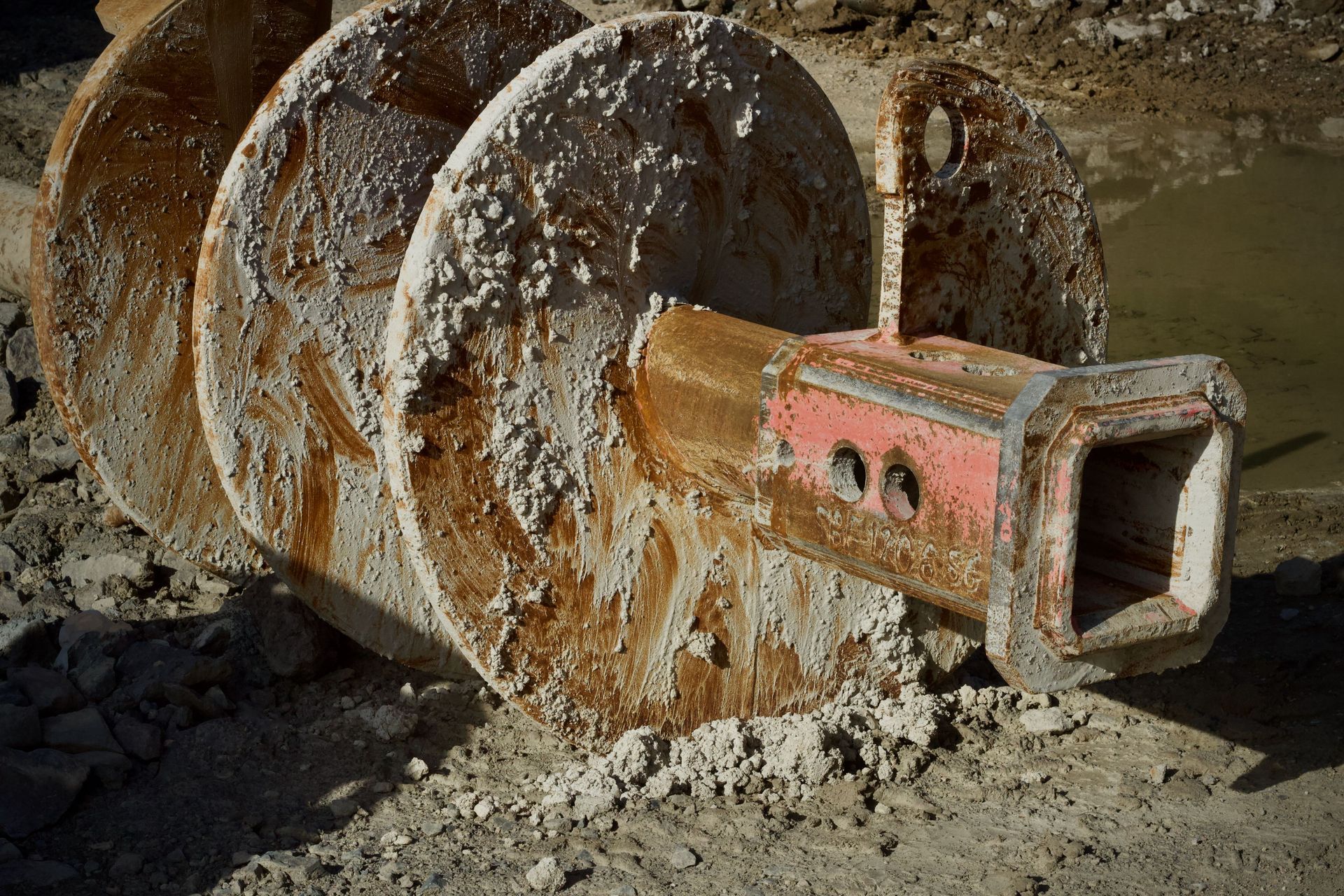
At its simplest, an auger is a large rotating screw designed to cut into earth.
The front of the auger breaks or cuts the soil. Spiral flights behind the cutting edge then help move loosened material away from the bottom or face of the hole.
That basic concept can be scaled from a small post-hole auger to large construction equipment.
With a vertical auger, the tool rotates downward into the ground and is periodically raised so excavated material can be removed from the hole.
With horizontal auger boring, the same screw-like principle works sideways. Excavated soil travels backward through a casing or bore toward the working pit as the cutting head moves forward.
The Federal Highway Administration describes the process clearly:
“The auger boring method forms a horizontal bore hole through the ground using a cutting head attached to a helically-wound auger flight.”
Source: Federal Highway Administration
That is very different from using an excavator to open a trench from the surface. Neither method is automatically better. They solve different construction problems.
Vertical Augering vs Horizontal Auger Boring
When someone says a project requires augering, your first question should be: Which kind?
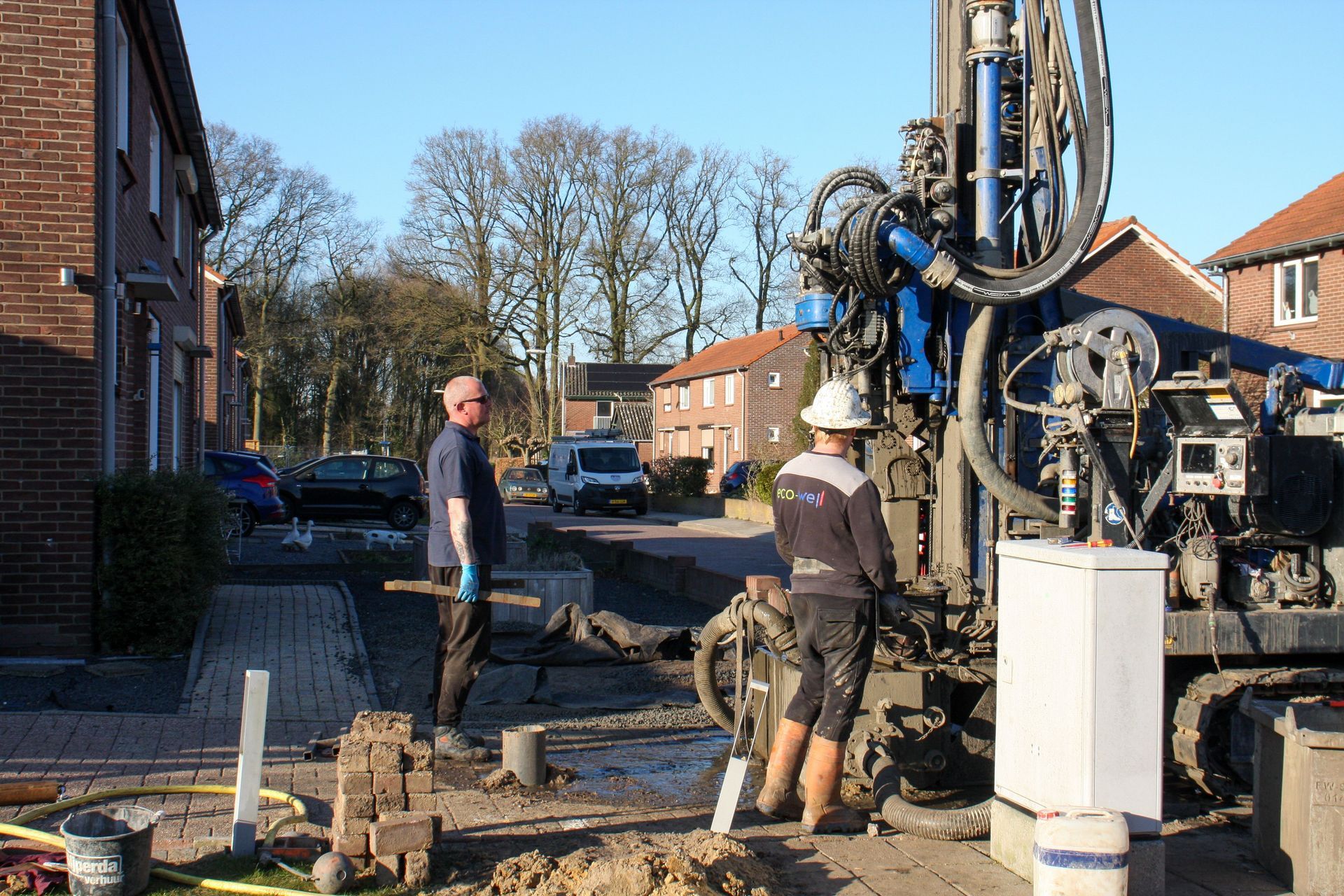
Vertical augering
Vertical augering is what most property owners picture first. A hydraulic auger mounted to a skid steer, excavator, drilling rig, or other machine drills a round hole downward.
Common applications can include light-pole foundations, fence or gate posts, sign structures, certain drilled foundations, structural piers, and other site infrastructure.
The advantage is control. Instead of excavating a large rectangular opening and then backfilling around a relatively small structural element, an auger can create a more concentrated excavation.
This can reduce soil disturbance and spoil quantities when conditions are favorable.
It does not remove the need for design. If the hole is for an engineered pier, the required depth, diameter, reinforcing steel, concrete, and bearing conditions still come from the appropriate design professional.
Horizontal auger boring
Horizontal auger boring solves a different problem.
Imagine that you need to install a waterline from one side of an existing paved road to the other.
You could open-cut the road. That might require pavement saw cutting, excavation, traffic control, utility installation, structural backfill, compaction, road-base replacement, asphalt restoration, and potentially a significant closure.
Or the project may be designed so a casing can be bored beneath the road.
That is where horizontal auger boring becomes valuable.
How Horizontal Auger Boring Works
Horizontal auger boring is commonly referred to as jack and bore.
A working pit is excavated on one side of the crossing. The boring machine is established at the required starting elevation and alignment.
A cutting head excavates the soil while a casing is pushed or jacked forward. Rotating auger flights inside that casing transport spoil backward to the launch pit.
FHWA's sample specification describes jack and bore as a system where:
“The ground up soil (spoil) is transported back to the entrance pit by helical wound auger flights.”
Source: Federal Highway Administration
Once one casing section has advanced, the equipment is repositioned, another section of casing and auger is connected, and boring continues.
Eventually the casing reaches the receiving side. A carrier pipe, conduit, or other utility can then be installed according to the project design.
“Trenchless” Does Not Mean “Excavation-Free”
This is an important misconception.
Horizontal auger boring is considered trenchless construction because you avoid excavating one continuous trench across the entire crossing.
You still need excavation.
A launch pit has to provide room for the boring machine, casing sections, workers, spoil, alignment, and equipment setup. Depending on the project, a receiving excavation may be necessary on the opposite side.
Those pits can be substantial.
They also have to be safely excavated, kept stable, protected from groundwater, and backfilled correctly when the bore is complete.
Afterward, conventional excavation may still be necessary to connect the new crossing to the rest of the utility system.
For an excavation contractor, the boring machine may be only one piece of the overall job.
Can You Auger Under a Road or Driveway?
Yes. Protecting existing roads and pavement is one of the reasons horizontal boring exists.
FHWA identifies auger boring as an established trenchless method for utility installation beneath roadways.
But being physically possible does not mean every crossing should be augered.
You have to compare the bore with open-cut construction.
If you have an unpaved driveway that is easy to excavate and restore, an open trench may be simpler and less expensive.
If you are crossing a heavily traveled paved road, the restoration and traffic impacts can make boring much more attractive.
The relevant comparison is not:
Cost to bore vs cost to excavate.
It is:
Total cost of boring vs total cost of opening, rebuilding, and restoring the crossing.
With open excavation, you may also be paying for pavement removal, road base, structural backfill, compaction testing, paving, traffic control, and additional downtime.
Auger Boring vs Horizontal Directional Drilling
These methods are often confused.
Horizontal directional drilling, commonly called HDD, typically begins with a smaller steerable pilot bore. The bore can then be enlarged before pipe is pulled through.
Traditional horizontal auger boring generally follows a more direct straight-line alignment and has much less steering capability.
FHWA notes that many auger-boring systems are comparatively unsteered and that unexpected obstacles such as large boulders can change the bore's course.
That distinction matters.
If you need a straightforward utility crossing beneath a road where line and grade can be established accurately from a launch pit, auger boring may make sense.
If the installation needs to follow a curved route, cross a longer distance, or navigate a complicated underground environment, a steerable drilling method may be more appropriate.
Neither should be treated as universally superior.
Why Line and Grade Matter
The starting position of an auger bore is extremely important because traditional systems may provide limited opportunities to correct the path once drilling has progressed.
The launch equipment has to be established on the correct alignment and elevation. FHWA guidance emphasizes the importance of a stable equipment foundation because settlement of the boring tracks can affect accuracy.
For a pressure waterline, a small grade difference may sometimes be manageable within the overall design.
For gravity sewer or drainage, grade can be much less forgiving.
If the final pipe needs gravity to carry water or wastewater, arriving at the wrong elevation can create a serious problem.
This is why survey control, setup, operator experience, and subsurface investigation matter before boring begins.
What Kind of Ground Can You Auger Through?
This is one of the most common real-world questions, and there is no single answer.
Clay
Clay may seem like ideal soil because it does not contain large stones, but dense clay can be surprisingly difficult.
Users in construction and fencing communities frequently report augers slowing dramatically when they reach hard clay. The auger can polish the sides of the hole rather than efficiently cutting deeper, especially when smaller or less powerful equipment is being used.
A hydraulic attachment on heavier equipment can behave very differently from a homeowner-grade one-person auger.
Sand and loose soil
Loose soils create a different problem.
They may cut easily, but the hole or excavation face has to remain stable. Horizontal boring methods have to account for soil moving into the bore or around the casing.
Gravel and cobble
Cobble is particularly relevant in Western Colorado.
Irregular rocks can slow drilling, jam tooling, or push a cutting head off alignment.
Boulders
A large boulder can stop an ordinary earth auger.
With vertical drilling, the contractor may be able to move the hole, excavate the obstruction, or use specialized tooling.
With horizontal boring beneath a road, the options can be more complicated because you cannot simply move the crossing several feet without considering engineering, property, utilities, and connections.
Rock
Some auger-boring systems can work in rock with appropriate tooling, but “can auger through rock” is too broad a statement to be useful.
Soft shale and competent bedrock are not the same condition. Tooling, machine torque, cutter design, bore diameter, and rock characteristics all matter.
Sometimes a different drilling or excavation method is more practical.
Why Western Colorado Ground Conditions Matter
Western Colorado excavation can change quickly from one site to another.
You may encounter clay in one portion of a project, gravel and cobble farther across the site, then shale or rock at depth.
That variability matters for augering because the cutting head encounters the subsurface directly.
A bore that progresses quickly through the first 20 feet may slow dramatically when it reaches a different material.
The same applies vertically. A skid-steer auger might make fast progress through ordinary soil and then appear almost useless when it reaches dense clay or embedded rock.
For you as the customer, this is why a contractor may provide different assumptions or contingency pricing for unexpected subsurface conditions.
Utility Locating Becomes Even More Important
You should never treat an auger as a way to avoid utility-location requirements.
Colorado 811 specifically lists auguring and boring among excavation activities.
That is logical when you consider what is happening underground.
With an open trench, the contractor gradually exposes more of the subsurface and can physically see many conflicts as excavation advances.
With horizontal boring, the cutting head can be several feet underground and tens of feet away from the operator.
That makes accurate planning critical.
Colorado 811's current professional-excavator workflow requires a locate request before excavation and directs contractors to wait for the applicable locate period, check Positive Responses, and confirm that field markings are complete before starting work.
Public locating is only one part of the process.
Private irrigation, septic piping, private waterlines, propane lines, electrical service between private structures, and other infrastructure may not be marked through the normal public locate system.
On ranches, commercial properties, and older Western Colorado sites, those private lines can be significant.
Sometimes a Utility Should Be Physically Exposed First
A colored paint mark gives you valuable information, but a critical crossing may justify physically confirming the utility's actual position and depth before a bore passes nearby.
That process is often called potholing or daylighting.
Depending on the conditions, crews may use careful hand excavation or vacuum excavation to expose the facility.
OSHA's excavation standard states:
“The estimated location of utility installations... shall be determined prior to opening an excavation.”
Source: Occupational Safety and Health Administration
For horizontal work, knowing a utility's actual three-dimensional position can be far more valuable than assuming the line is exactly where expected based on paint alone.
Augering Has Its Own Safety Hazards
The auger's power is exactly what makes it useful, and what makes it dangerous when something goes wrong.
OSHA maintains specific guidance on the Hazards of Auger Drilling because rotating augers can create entanglement, struck-by, equipment-movement, and utility hazards.
Workers need to stay clear of rotating flights and cutting components.
An auger can also develop significant reaction torque if the cutting head suddenly catches a hard obstruction.
This is something you see repeatedly in homeowner and contractor discussions about smaller post-hole augers. Users frequently mention how dramatically the machine can react when the bit catches rock or roots.
With construction-scale equipment, those forces are larger and require proper equipment setup, operation, guarding, and work-zone control.
The Launch Pit Is Still an Excavation
Horizontal boring also introduces ordinary trench and excavation hazards.
A deep launch pit can cave in.
Groundwater can accumulate.
Equipment places surcharge loads around the pit.
Workers need safe access.
The contractor therefore has to evaluate pit depth, soil, protective systems, spoil placement, water, equipment location, and other OSHA excavation requirements.
Calling the project trenchless does not make those hazards disappear.
How Augering Fits Into a Utility Project
Imagine you are installing a new waterline across a Western Colorado property.
Most of the route might be installed using conventional trench excavation. Then the alignment reaches an existing county road.
Instead of opening that road, the design may call for a casing beneath it.
The excavation contractor trenches the approaching line, prepares the launch area, manages the spoil, and coordinates the crossing. A specialized boring operation completes the underground section.
On the other side, conventional trenching resumes.
When the system is installed, the pits and trenches are backfilled and compacted. The road shoulder, property, drainage, or landscaping is restored.
That example illustrates how augering fits naturally into broader utility installation and repair. It may represent only a small percentage of the total utility length while solving one of the most difficult parts of the project.
What Happens to the Dirt From an Auger Bore?
It still has to go somewhere.
Horizontal auger flights carry spoil back into the launch pit. That soil may be stockpiled, reused, or removed depending on the project.
Vertical augering similarly generates material that accumulates around the hole as the tool is withdrawn.
On a few post holes, this may be trivial.
On a large-diameter or longer boring project, spoil management becomes part of the project logistics.
Able Excavation's trucking and hauling services include excavated material and spoil haul-off as well as delivery of gravel, fill, and other construction materials. That matters because boring pits may ultimately need suitable backfill brought back after unsuitable spoil leaves the site.
When Is Open Trenching Better?
Augering is useful, but it should not be selected simply because it sounds more advanced.
If the surface is easy to disturb and restore, conventional trenching may be more economical.
Open excavation also gives the crew direct access to utilities, bedding, connections, and subsurface conditions throughout the alignment.
If several pipes need to occupy the same corridor, one trench may be more practical than multiple bores.
Heavy cobble, unpredictable boulders, or rock can also change the economics.
The correct method comes from comparing the complete construction process.
When Can Augering Save You Money?
Augering becomes especially attractive when the cost of disturbing the surface is high.
A road crossing is the obvious example.
Open cutting may involve pavement demolition, traffic control, structural backfill, compaction, paving, striping, inspections, and longer disruption.
The bore itself may cost more per linear foot than digging an ordinary trench across open ground, but it can avoid many of those restoration costs.
Commercial sites offer another example. A bore beneath a developed entrance or parking area may preserve customer access and reduce surface reconstruction.
That has economic value beyond the excavation price alone.
What Determines the Cost of Augering?
The first variable is size.
A small vertical hole for a sign foundation is not comparable to a large casing beneath a roadway.
Horizontal bore length matters because more casing, auger sections, time, thrust, and spoil handling are involved.
Ground conditions can have an even greater effect. Easy cohesive soil may allow consistent production. Cobble, boulders, rock, groundwater, or unstable soils can slow the project or force a change in method.
Then you need to account for everything surrounding the bore.
That may include survey, utility locating, potholing, launch and receiving excavation, casing, equipment mobilization, traffic control, dewatering, spoil removal, backfill, compaction, and site restoration.
This is why a contractor should be hesitant to give you one universal “augering price per foot” without knowing what the project actually requires.
Is Augering Always More Precise Than an Excavator?
It depends on what you mean by precise.
A vertical auger can create a clean, repeatable diameter that would be difficult to reproduce with a large excavator bucket.
Horizontal auger boring can also create a controlled utility path beneath an obstruction.
But traditional horizontal auger boring may have relatively limited steering.
An excavator working in an open trench can follow surveyed alignment while continuously exposing the work area. If an obstruction appears, the operator and project team can see it and adjust the trench within allowable project constraints.
So augering can be more geometrically controlled in one sense while providing less adaptability in another.
Does Able Excavation Perform Auger Boring?
Able Excavation's published services currently focus on full-service excavation, utility installation and repair, HDPE pipe fusing, road and subdivision work, drainage, commercial excavation, and trucking rather than specifically advertising specialized horizontal auger-boring equipment.
That distinction is worth making.
On a project that requires a specialized bore, a full-service excavation contractor can still play an important role in preparing the site, excavating working pits, installing and connecting utilities, coordinating grades, handling spoil, providing trucking, compacting backfill, and restoring the project afterward.
Able's broader excavation services cover those surrounding scopes throughout Western Colorado.
For you as the customer, the goal should be a coordinated project rather than assuming one machine or one contractor must personally perform every specialized operation.
Common Questions About Augering
How deep can an auger drill?
There is no universal maximum depth. It depends on the machine, bit or flight configuration, diameter, soil, access, and application.
A homeowner post-hole auger and a construction drilling rig should not be compared using the same depth limits.
Can an auger go through tree roots?
It may cut some roots, but that does not mean you should casually drill through them. Large roots can catch equipment, and removing structural roots can damage or destabilize nearby trees.
Can you auger underneath a septic system?
That should not be treated as a routine shortcut. Septic tanks, piping, treatment areas, and reserve areas should be identified and protected. Any crossing needs to be evaluated within the overall septic and utility plan.
Can you auger a gravity sewer?
Horizontal boring can be used in wastewater applications, but gravity sewer makes elevation control particularly important. The method must be capable of meeting the required line and grade.
What happens when an auger gets stuck?
The contractor first needs to determine why. Possible causes include hard soil, rock, boulders, roots, tooling problems, or excessive resistance.
The correct response may involve reversing or withdrawing appropriate equipment, changing tooling, exposing the obstruction, or selecting another construction method. Workers should never improvise around rotating equipment.
Is a bigger auger always better?
No.
A larger diameter removes more soil and typically requires more torque. The hole should be sized for the actual structure, casing, pipe, or design requirement.
Oversizing can increase spoil, equipment needs, and cost without adding value.
Final Takeaway
Augering is valuable because it gives excavation contractors and project designers another way to work with the ground.
Vertical augering can create controlled holes for poles, piers, signs, and structural elements with less disturbance than a larger open excavation.
Horizontal auger boring can carry utilities beneath roads, driveways, and developed surfaces while leaving much of the ground above intact.
But neither method is simply a matter of putting an auger on a machine and drilling.
Soil conditions, cobble, rock, groundwater, utilities, line and grade, bore length, casing, equipment access, safety, permits, spoil, and restoration all influence whether augering makes sense.
For Western Colorado projects, that evaluation is especially important because ground conditions and access can change quickly. A method that performs well in ordinary soil may behave very differently once it reaches hard clay, cobble, shale, or bedrock.
The best project therefore starts by asking a broader question than “Can we auger it?”
You should ask: What excavation method gives this project the safest, most reliable, and most economical finished result?
Sometimes that answer is an auger. Sometimes it is an excavator. Sometimes it is directional drilling. And on many successful projects, it is a carefully coordinated combination of several methods.
Share this article
Recent Posts